Key Points
- Nationwide demonstrations saw 550,000 citizens take to the streets across France on 17 October, protesting against rising living costs, failing public services, and acute educational inequality.
- Intense clashes erupted between law enforcement and opportunist rioters (casseurs), forcing the French Government to enact partial curfews in major metropolitan areas, including Paris, Marseille, Lille, Nantes, and Lyon.
- Multiple severe injuries were recorded during police enforcement operations, including two teenagers who had hands severed by stun grenades, a 16-year-old who lost an eye to a rubber bullet, and a 14-year-old who suffered a shattered jaw from a point-blank grenade explosion.
- The historic town hall of Limoges, a listed national monument, was torched and its clock tower destroyed in flames, drawing national comparisons to the 2019 Notre-Dame Cathedral fire.
- Political friction has intensified six months ahead of the French presidential election, with the centrist-right Macronist Government blaming the ‘ultra-left’ and Jean-Luc Mélenchon, while far-right leader Marine Le Pen calls for zero tolerance.
- Civil unrest has breached French borders, spilling over to Albania, Italy, Belgium, Spain, and Greece as Generation Z mobilises against systemic economic and institutional crises.
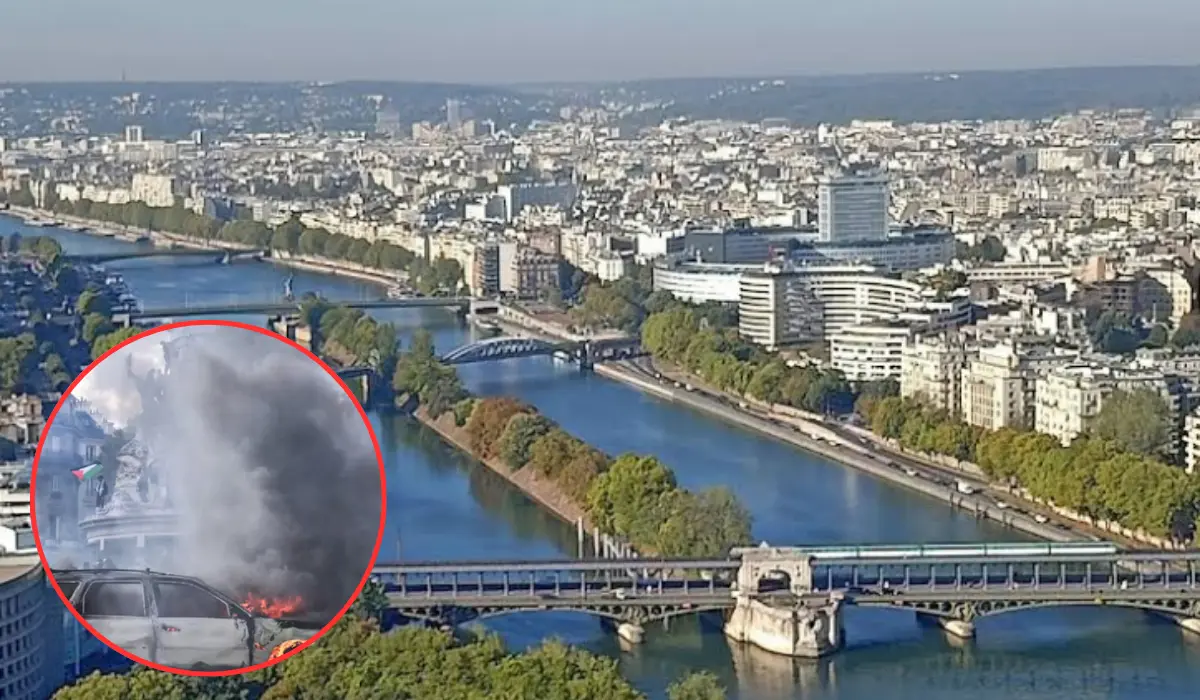
Paris (France News7) October 27, 2026 – A wave of violent civil unrest, widespread looting, and structural destruction has left France shell-shocked following a month of nationwide student-led blockades that spiralled into severe urban chaos. What began as a peaceful national demonstration of 550,000 citizens on 17 October has rapidly deteriorated into intense clashes between riot squads and opportunistic groups known as casseurs (‘breakers’), compelling municipal authorities to impose partial curfews in major cities. The turmoil has claimed historic architecture—including the destruction of the listed city hall in Limoges—and sparked severe public outrage over contentious police tactics. As political leaders exchange accusations six months prior to the upcoming presidential election, the student movement has crossed international borders into southern and western Europe.
- Key Points
- What Triggered the Escalation of Nationwide Student Protests Across France?
- How Did a Peaceful Demonstration Transpire into Mass Urban Violence?
- What Concerns Have Been Raised Regarding Police Tactics and Student Injuries?
- How Severe Was the Cultural and Physical Destruction in Limoges?
- How Are Political Factions Reacting Ahead of the Presidential Election?
- How Has the French Protest Movement Spread Across Europe?
- Background of the Particular Development
- Prediction: How This Development Can Affect European Youth and Political Systems
What Triggered the Escalation of Nationwide Student Protests Across France?
The widespread movement initially materialized in September as a localized high-school blockade in a low-income suburb of Paris. Students organized the initial action to condemn what they characterized as deplorable, unsafe conditions within the national public education system. School children reported enduring months without assigned teaching staff due to acute national labor shortages, persistent roof leaks during rainstorms, severe classroom overcrowding, and an insufficient supply of basic desks and chairs.
As detailed in frontline reporting by journalist Vivian Song of Grazia, the suburban blockade quickly gained viral traction across digital social platforms. Secondary school pupils across the country began sharing documented accounts of severe building neglect, detailing widespread rat infestations, unusable sanitary facilities, and collapsed ceiling structures.
The viral movement prompted secondary blockades that forced the immediate closure of hundreds of educational facilities nationwide and necessitated large-scale police deployments. The high-school movement progressively coalesced with broader social factions, drawing formal backing from university student organizations, national trade unions, and members of the Yellow Vests—a grassroots movement originally formed in 2018 to combat soaring energy prices and living costs.
How Did a Peaceful Demonstration Transpire into Mass Urban Violence?
On 17 October, the student movement orchestrated a massive national day of action. Official estimates confirmed that 550,000 people assembled across French cities to demonstrate against escalating inflation, decaying public infrastructure, and systemic educational inequality.
In central Paris, the rally initially projected an atmosphere of civic unity. As documented by Vivian Song of Grazia, a 400-piece orchestra gathered at Place de la République to perform the main theme song from The Avengers, while families accompanied by young children held handmade placards decorated with rainbows and hearts as they awaited the main procession.
However, the peaceful demonstrations were rapidly eclipsed by violent escalations. Groups of radicalized rioters, referred to domestically as casseurs, infiltrated the crowds, setting vehicles alight, vandalising municipal infrastructure, and launching targeted attacks against commercial premises. In Paris, violent clashes rapidly outstripped local law enforcement control limits. Opportunistic looters targeted commercial venues without distinction, ransacking high-end boutiques alongside small independent retail establishments and neighborhood wine shops.
Widespread arson, property destruction, and commercial looting were subsequently confirmed in Marseille, Lille, Nantes, and Lyon. The scale of street violence ultimately forced the French Government to enact localized emergency curfews across affected urban centers to regain public control.
What Concerns Have Been Raised Regarding Police Tactics and Student Injuries?
Parallel to France’s long-established tradition of public street resistance, national law enforcement agencies faced intense international scrutiny regarding their heavy-handed riot control protocols. As the street clashes escalated, multiple student demonstrators reportedly suffered catastrophic physical injuries during tactical dispersals executed by police units.
As reported by journalist Vivian Song of Grazia, non-governmental sources and eyewitness accounts documented several critical casualties among teenage marchers:
- Stun Grenade Amputations: Two separate blast incidents reportedly resulted in two teenagers having their hands blown off by police-issued stun grenades.
- Kinetic Impact Munitions: A 16-year-old protest participant reportedly lost an eye after being struck by a rubber bullet fired during crowd suppression operations.
- Close-Range Explosions: A formal police officer investigation was launched after video footage emerged depicting a tactical grenade exploding directly in the face of a 14-year-old boy at close range, an impact that shattered his jaw and dislodged most of his teeth.
The publication of video evidence detailing these severe injuries triggered widespread domestic condemnation and amplified calls for immediate independent oversight of riot policing methods.
How Severe Was the Cultural and Physical Destruction in Limoges?
While commercial looting affected numerous metropolitan areas, the single most destructive incident of historic vandalism occurred in the central French city of Limoges.
As reported by reporter Vivian Song of Grazia, violent perpetrators breached and set fire to the historic Limoges City Hall (Hôtel de Ville). Circulating video documentation recorded the complete collapse of the building’s central clock tower as flames engulfed the structure.
The municipal building held status as a protected national historic monument (monument historique). Its destruction evoked widespread public grief, drawing immediate cultural comparisons across the country to the catastrophic 2019 blaze that destroyed the roof of Notre-Dame Cathedral in Paris. Because town halls function as the civic and administrative heartbeat of French local life, the destruction of the Limoges structure dealt a profound symbolic blow to the nation’s architectural heritage.
How Are Political Factions Reacting Ahead of the Presidential Election?
The ongoing unrest has intensified political divisions across France, occurring precisely six months prior to a scheduled presidential election in which far-right parties currently maintain a lead in public opinion polls.
Political figures across the spectrum have engaged in mutual recriminations:
- The Macronist Centrist-Right Government: Officials representing the governing coalition have attributed the violence to radicalized elements, explicitly accusing Jean-Luc Mélenchon, presidential candidate and figurehead of the far-left party France Unbowed (La France Insoumise), of intentionally inciting public unrest. Ministers characterized the core rioters as violent agents belonging to the ‘ultra-left’.
- Jean-Luc Mélenchon and the Opposition Left: Mélenchon rejected the administration’s accusations, countering that the executive branch’s handling of the crisis demonstrated severe institutional incompetence or deliberate political manipulation designed to discredit peaceful social movements.
- Marine Le Pen and the National Rally: Marine Le Pen, leader of the anti-immigrant National Rally (Rassemblement National) and current presidential frontrunner, has leveraged the chaos to champion an unyielding “zero-tolerance” policy to restore state authority, positioning her party as the sole guarantor of law and order.
The domestic crisis has also drawn commentary from foreign political figures. United States President Donald Trump and Vice President JD Vance publicly issued statements linking the civil disorder in French cities to national immigration policies, a narrative rejected by organizers of the student movement.
How Has the French Protest Movement Spread Across Europe?
The civil unrest original to French municipalities has crossed national boundaries, triggering derivative youth demonstrations across multiple European nations. At the time of reporting, student groups inspired by the French blockades had staged street marches and protests in Albania, Italy, Belgium, Spain, and Greece.
International student groups voiced shared complaints regarding localized economic pressures, including steep hikes in university tuition fees, soaring residential rent costs, systemic housing shortages, and chronically underfunded public school systems. Analysts note that Generation Z activists are increasingly mobilizing against a broader “polycrisis”—a convergence of economic instability, prospective mass unemployment, climate degradation, and perceived threats to democratic institutions. However, student organizers across Europe have expressed regret that their substantive policy demands remain consistently overshadowed by violent street clashes and property destruction.
Background of the Particular Development
The explosive civil disorder observed across France in October 2026 represents the culmination of years of mounting socio-economic strain, budgetary austerity, and institutional friction between youth demographics and the state. France possesses a long history of organized civil resistance, ranging from the historic student uprisings of May 1968 to the prolonged nationwide mobilization of the Yellow Vests (Gilets Jaunes) in 2018.
Over the past decade, successive French administrations have faced structural challenges in maintaining public service infrastructure amid inflationary pressures and fiscal constraints. The national secondary and tertiary educational sectors, in particular, have suffered from chronic structural underfunding, leading to severe staffing shortages, overcrowded facilities, and neglected municipal building conditions.
Simultaneously, French policing strategies have faced recurring domestic and international scrutiny. The deployment of heavy crowd-control weaponry—including kinetic impact projectiles (rubber bullets) and explosive defensive grenades (grenades de désencerclement)—has historically resulted in severe injuries during public demonstrations, creating deep-seated animosity between youth activists and riot police forces.
When high-school students in Paris’s lower-income outer suburbs initiated targeted blockades in September 2026, their localized grievances acted as a catalyst for a broader demographic that felt economically marginalized by rising living costs and neglected by the political establishment. The subsequent convergence of peaceful student activists, unionized trade workers, veteran Yellow Vest marchers, and violent opportunistic elements (casseurs) created an unstable environment that rapidly escalated beyond municipal containment capabilities.
Prediction: How This Development Can Affect European Youth and Political Systems
The violent escalation of the October 2026 unrest is poised to significantly alter the domestic political landscape in France while reshaping youth activism and security governance across the European continent:
1. The French Electorate and the Upcoming Presidential Election
With the presidential vote just six months away, the lingering images of burning municipal monuments, looted commercial districts, and urban curfews will likely accelerate a rightward shift among voters. Marine Le Pen and the National Rally stand to gain substantial political momentum by capitalizing on widespread voter anxieties regarding public safety and institutional decay. Conversely, the governing centrist coalition risks further alienation: conservative voters view its security response as indecisive, while progressive voters are appalled by reported police brutality against teenage demonstrators.
2. European Generation Z and Social Movement Dynamics
As youth-led Protests expand into Albania, Italy, Belgium, Spain, and Greece, European governments face an increasingly organized generation willing to deploy disruptive tactics to highlight economic grievances. However, the hijacking of student blockades by violent casseurs poses a double-edged sword for Generation Z. While radical tactics capture global media attention, the resulting property destruction risks alienating middle-class public support, enabling governments to justify harsher security crackdowns and sweeping legislative restrictions on the right to assembly.
3. Public Security Frameworks and Police Governance
The severity of injuries inflicted on underage marchers will inevitably force a rigorous legal and political re-examination of French riot control protocols. European human rights monitoring bodies and parliamentary committees are likely to increase pressure on the French Interior Ministry to restrict or ban the operational use of explosive stun grenades and rubber bullets in civilian areas. However, given the destruction of historic landmarks like the Limoges City Hall, law enforcement agencies may simultaneously receive expanded statutory powers and emergency curfew authorities to preemptively dismantle future blockades.