Key Points
- Escalating Industrial Action: French trade unions and student organisations have called for a fresh wave of nationwide demonstrations on Saturday, 31 October 2026, followed by a major general strike on 5 November 2026.
- Widespread Mass Mobilisation: Official estimates placed the turnout of last weekend’s nationwide demonstrations between 400,000 and 800,000 participants (with the Interior Ministry recording 410,000), overseen by a massive police deployment of 70,000 officers.
- Mass Arrests and Severe Casualties: Authorities carried out over 1,300 arrests nationwide following nighttime clashes. The violence left 53 police officers injured and two demonstrators seriously wounded, including a 20-year-old man in Toulouse whose fingers were severed by an explosive device.
- Government Security Crackdown: Interior Minister Laurent Nuñez warned of further potential violence, promising an “extremely robust” police response. Nighttime curfews were instituted in major urban centers, including Paris, Lyon, Nice, and Lille, alongside fast-track judicial procedures for vandalism and looting.
- Political Accusations: President Emmanuel Macron accused radical agitators of “sedition” aimed at undermining the republic, while union leaders counter that the government’s security-first response is only hardening public resolve amidst a severe cost-of-living crisis.
PARIS (France News7) October 26, 2026 — Executive Summary: France is preparing for widespread civil disruption as trade unions expand street protests into a general strike. Following a weekend of intense social unrest that resulted in more than 1,300 arrests, union federations are calling for fresh demonstrations on Saturday, 31 October, followed by a nationwide industrial walkout on 5 November. President Emmanuel Macron’s administration has deployed nighttime curfews and fast-track courts to restore order, while union leaders maintain that security crackdowns will only drive higher turnout across picket lines.
- Key Points
- What Prompts French Unions to Declare Further Demonstrations and a General Strike?
- How Did Weekend Demonstrations Escalate Into Urban Clashes and Mass Arrests?
- How Is the French Government Responding to the Security Threat?
- Background of the particular development
- Prediction: How This Development Can Affect the General Public, Workers, and Businesses
What Prompts French Unions to Declare Further Demonstrations and a General Strike?
As reported by Stuart Williams of Agence France-Presse (AFP), hundreds of thousands of people took to the streets across France on Saturday to protest against the rapidly escalating cost of living, deteriorating conditions in public secondary schools, and high taxation.
The momentum behind the social movement is accelerating rapidly. In an interview broadcast on BFM TV, Murielle Guilbert, co-leader of the left-wing Solidaires trade union federation, stated that the country was witnessing a significant aggregation of discontent across multiple demographics. Guilbert explained that grievances held by students, public transport workers, healthcare personnel, and firefighters were converging into a unified front against government policy. Consequently, labor organizations are urging citizens to maintain pressure by taking to the streets on Saturday, 31 October, before mounting a full coordinated general strike on 5 November.
As covered by news organizations including Reuters and The Guardian, student groups in major metropolitan centers such as Lyon and Marseille are actively preparing campus blockades and secondary school walkouts to coincide with the broader trade union actions. Commuters and logistics operators across the south and west of France have been advised by local government agencies to prepare for major bottlenecks and severe transit disruptions near critical transportation hubs.
How Did Weekend Demonstrations Escalate Into Urban Clashes and Mass Arrests?
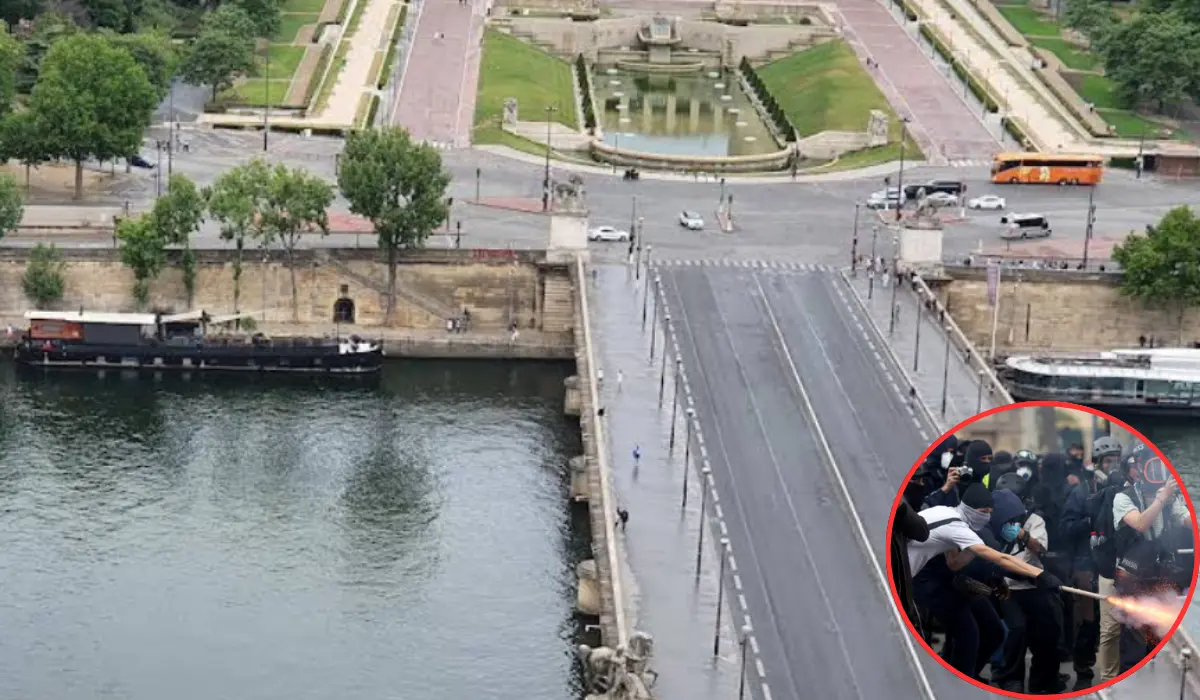
As reported by AFP and Reuters, daytime marches across the country were predominantly peaceful, but violence erupted in major urban centers as night fell. Across France, official interior ministry tallies indicated that between 400,000 and 800,000 people took part in the demonstrations, monitored by a contingency of 70,000 police officers.
According to journalists reporting for DW and Anadolu Ajansı, riot police in Paris were forced to deploy tear gas, high-pressure water cannons, and elite anti-crime units near the Porte de Vincennes area after masked groups erected street barricades and smashed the glass facades of commercial car dealerships. Over 142 individuals were taken into custody within the capital alone, contributing to a nationwide total exceeding 1,300 detentions.
Similar volatile skirmishes were reported across regional centers:
- Marseille: As detailed by local observers for AFP, demonstrators set fire to public refuse bins, and local authorities confirmed that at least seven businesses suffered physical damage or looting during the evening unrest.
- Lyon & Montpellier: Police units fired canisters of tear gas to push back dense crowds that had congregated inside officially designated restricted security zones.
- Bordeaux: Demonstrators dismantled wooden construction hoardings from local commercial structures to construct improvised barriers against advancing police lines.
As reported by AFP and Newscord, the clash resulted in 53 police officers sustaining injuries. Additionally, two demonstrators suffered severe injuries, including a 20-year-old protester in Toulouse who suffered severed fingers caused by an exploding pyrotechnic or crowd-control device.
How Is the French Government Responding to the Security Threat?
As reported by Europe 1 and AFP, Interior Minister Laurent Nuñez stated that the French state was clearly expecting risks of further trouble as union leaders encouraged workers in the public transport, energy, and education sectors to walk off the job. Nuñez pledged that security forces would maintain an “extremely robust” presence in the coming days, asserting that authorities would not tolerate further public disorder or destruction of property.
In an attempt to regain control of the public space, President Emmanuel Macron and his cabinet implemented strict nighttime curfews across identified violence hotspots in Paris, Lyon, Nice, and Lille. Furthermore, decrees issued from the Élysée Palace established that public demonstration permits would be restricted exclusively to officially recognized trade union marches.
Addressing the national situation, President Macron emphasized that the primary priority of the government was a swift return to calm. Macron accused radical agitators of engaging in “sedition” and claimed that the worst instances of urban violence were orchestrated by organized political factions intent on bringing down the republic. To expedite legal consequences, authorities have directed judicial prosecutors to utilize fast-track courts to hand down immediate prison sentences for acts of arson, looting, and street vandalism.
Background of the particular development
The current wave of civil unrest represents the culmination of mounting socio-economic pressure on President Emmanuel Macron’s administration, which is operating under tight political margins with presidential elections scheduled in six months. Over the past two years, France has grappled with persistent inflation, driven by elevated energy tariffs and rising food prices, which has significantly eroded household purchasing power across both urban and rural demographics.
Public sector grievances have also grown increasingly severe. Secondary school educators and academic staff have repeatedly staged local strikes over systemic underfunding, overcrowded classrooms, and deteriorating infrastructure. Simultaneously, public transit and energy workers have demanded indexed wage adjustments to match the cost of living.
These economic factors are unfolding against the backdrop of a long-standing history of intense French street politics. Reminiscent of the “Yellow Vest” (Gilets Jaunes) demonstrations that began eight years prior, the current movement has drawn together diverse, decentralized factions—including student groups, trade unions, and informal local committees—creating a broad front that challenges the government’s ability to maintain public order through standard legislative mechanisms.
Prediction: How This Development Can Affect the General Public, Workers, and Businesses
The scheduled escalation toward a nationwide general strike on 5 November poses immediate and strategic consequences for several key segments of French society:
1. Commuters and the General Public
The planned industrial walkouts across public transportation and regional rail lines are expected to cause severe logistical paralysis. Daily commuters in major urban hubs will face cancelled train schedules, severe road congestion, and restricted municipal transit access. Furthermore, secondary school blockades and educator strikes will disrupt childcare and primary education routines, forcing families to make last-minute operational arrangements.
2. The Commercial Sector and Local Businesses
Retailers, hospitality operators, and transport-dependent businesses face renewed financial strain. The combination of nighttime curfews, physical store damage, and decreased foot traffic during key shopping windows risks driving down revenue in major city centers like Paris, Lyon, and Marseille. Insurance claims and security expenditures are anticipated to surge as shop owners prepare for potential spillover violence during weekend demonstrations.
3. Trade Unions and Industrial Workers
For organized labor, the turnout on 31 October and 5 November represents a critical test of collective bargaining leverage. A strong, disciplined turnout could force government ministers to the negotiating table to offer concessions on tax policy, education budgets, or living-cost subsidies. Conversely, if demonstrations are overshadowed by rioting, public support may shift toward the government’s law-and-order stance.
4. The Macro-Political Landscape
With presidential elections looming in six months, President Macron’s handling of this crisis will shape the political discourse. Continued escalation without diplomatic resolution risks further alienating moderate voters, while empowering opposition candidates from both the far-left and far-right who are seeking to capitalize on public dissatisfaction with the administration’s economic management.
This coverage highlights the escalating tensions between labor movements and state authorities in France, detailing how recent weekend clashes have laid the groundwork for a critical period of industrial action. For visual context on how these civil demonstrations unfold on the ground, view this coverage detailing the scale of recent street protests: French Protests and Police Confrontations. This footage provides direct context on the law enforcement deployments and crowd dynamics described by interior ministry officials