Key Points
- On November 7, 2026, high school students, university students, workers, and Yellow Vests demonstrated across France for the fourth consecutive Saturday against the rising cost of living.
- Official Interior Ministry statistics counted 146,000 demonstrators nationwide (including 46,000 in Paris), whereas youth inter-union alliance figures estimated attendance at 250,000 (75,000 in Paris).
- The French state deployed approximately 70,000 police and gendarmes, resulting in 360 arrests nationwide, including the detention of Yellow Vest Coordination spokespeople Benjamin Ball and Azelma Sigaux in Paris.
- Following a meeting on Monday with Prime Minister Sébastien Lecornu, major trade union leaderships proposed a cross-industry strike for November 17, while the CFDT declined to call for further strike action.
- Demonstrators interviewed during the mobilization reported heavy police repression, including head injuries from rubber-bullet launchers (LBDs) and batons, while expressing opposition to austerity, war budgets, and the normalization of the far right.
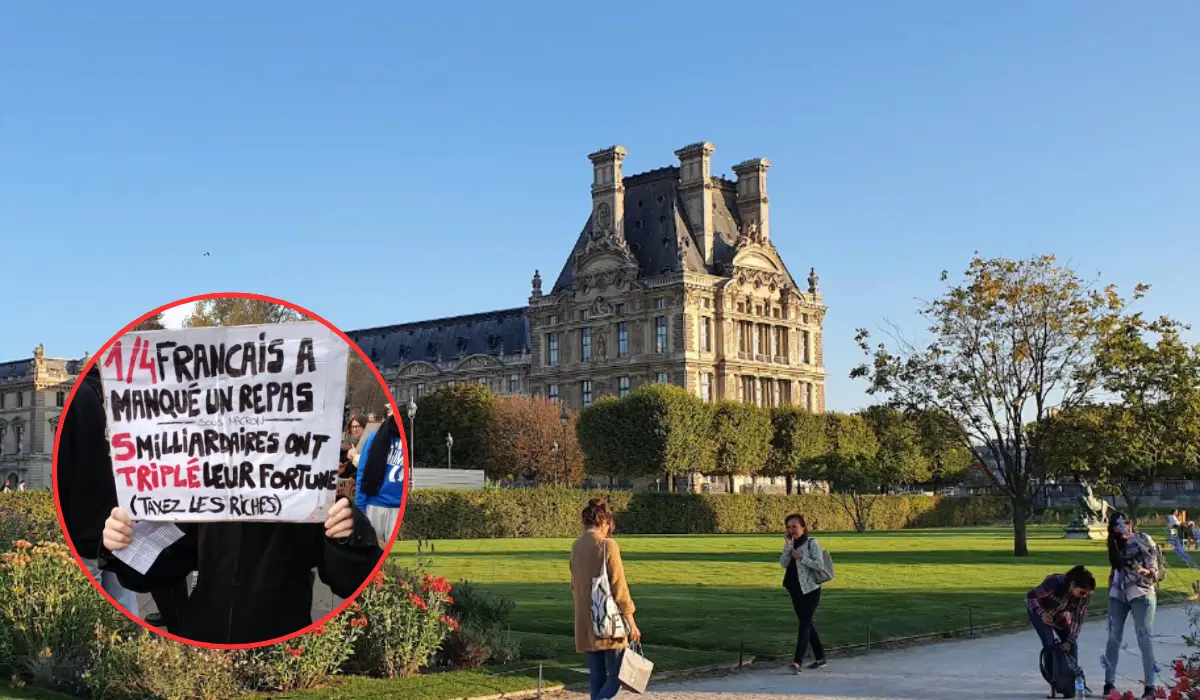
Paris (France News7) November 11, 2026 – Tens of thousands of workers, university students, high school pupils, and Yellow Vest activists took to the streets across France on November 7 for the fourth consecutive Saturday of nationwide demonstrations against inflation, police violence, and government austerity measures. Responding to a joint call by youth organizations and the Yellow Vest Coordination, protests took place in major urban centers including Paris, Bordeaux, Grenoble, Rennes, Lille, Marseille, Toulouse, Nantes, Montpellier, and Lyon. The mobilization coincided with ongoing talks between major trade union confederations and the government of Prime Minister Sébastien Lecornu to schedule a national cross-industry strike for mid-November.
- Key Points
- What Are the Conflicting Attendance Figures and Police Action Reports across France?
- How Are French Trade Unions Coordinating Strike Actions with the Government?
- What Concerns Are Demonstrators Raising Regarding Police Violence and Economic Inflation?
- Background of the Particular Development
- Prediction: How This Development Can Affect French Workers, Students, and Business Operations
What Are the Conflicting Attendance Figures and Police Action Reports across France?
Discrepancies emerged between state authorities and trade union organizers regarding the scale of public participation in Saturday’s demonstrations. According to figures released by the Interior Ministry, 146,000 people protested across the country, with 46,000 identified in Paris. Conversely, the youth inter-union alliance reported a national turnout of 250,000 demonstrators, including 75,000 in the capital.
Regional estimates published by trade unions similarly exceeded official prefecture counts. In Bordeaux, the CGT reported 40,000 marchers compared to the state figure of 9,100. In Grenoble, union officials counted 20,000 marchers against a prefecture estimate of 6,000, while in Rennes, Sud Solidaires claimed 10,000 participants compared to the 5,500 reported by local authorities.
To manage the demonstrations, many of which proceeded in direct defiance of local prefectoral gathering bans, the French government mobilized roughly 70,000 police officers and gendarmes nationwide. The Interior Ministry confirmed 360 arrests across France over the course of the day. In Paris, law enforcement officers arrested Yellow Vest Coordination spokespeople Benjamin Ball and Azelma Sigaux directly in front of the National Assembly before placing them in police custody. In Toulouse, prefectoral authorities confirmed 24 arrests following police actions involving tear gas against a prohibited gathering.
How Are French Trade Unions Coordinating Strike Actions with the Government?
Following the Saturday demonstrations, trade union leaderships held a formal meeting on Monday with Prime Minister Sébastien Lecornu to discuss the scheduling of upcoming industrial action. Having previously organized a single-day cross-industry strike on November 5, the union representatives proposed a subsequent national strike date for November 17.
However, the CFDT union leadership abstained from issuing a call for the upcoming strike. As reported by WSWS reporters, the union leaderships met with Prime Minister Sébastien Lecornu to set the next one-day strike, a move described by WSWS reporters as an attempt “to keep dictating the pace of the mobilization together with the government and to prevent an uncontrolled social explosion.”
What Concerns Are Demonstrators Raising Regarding Police Violence and Economic Inflation?
During demonstrations at the Place de la République in Paris, marchers voiced concerns regarding living standards, state surveillance, and tactical police responses.
As reported by WSWS reporters, a student named Robin stated that she had previously encountered tactical law enforcement measures during earlier demonstrations regarding police weaponry, stating: “I had really been confronted with police violence, actually, and it completely outraged me. And I’m not in high school anymore, but I was, and the working conditions, how we students were treated in terms of mental health, the infrastructure. Nothing was right.” Robin also highlighted economic pressures, adding: “Prices going up, that makes no sense at all. Families who can’t afford a normal life, you can’t have a dignified life for reasons of money.”
Street medic and welder Lucas provided accounts of medical interventions during prior demonstrations on October 17. As reported by WSWS reporters, Lucas stated: “On October 17, we did nine stretcher evacuations. At the little café up there, we had set up a small first-aid point. We put all the seriously injured there, and then we evacuated them … It was LBDs [rubber-bullet launchers], batons, and we dealt with quite a few head injuries. We treated a lot of trauma.” Lucas expressed skepticism toward union officials, remarking that “all that’s left is to scream; they don’t see any further than the end of their noses,” while calling for broader international solidarity across European workers and youth.
Furthermore, students Apolline, Camille, and Chloé addressed government policy and state expenditure. As reported by WSWS reporters, Apolline stated: “The repression against high school students is absolutely disgusting. They’re mobilizing for their rights, and they get beaten, they get maimed. The right to demonstrate is written into the Constitution, after all; that’s what we have to respect.” Camille questioned state military spending, stating: “The cost of the budget for these wars … personally, I think this money could be put somewhere else.”
Background of the Particular Development
The wave of demonstrations on November 7, 2026, represents a continuation of social unrest that has characterized French domestic politics since the emergence of the Yellow Vest (Gilets Jaunes) movement in November 2018. Originally sparked by fuel tax increases, the movement evolved into a broader protest against economic inequality, falling purchasing power, and the executive policies of President Emmanuel Macron.
In recent years, economic pressures across France have intensified due to sustained post-pandemic inflation, rising energy costs, and constitutional maneuvers utilized by the executive branch to bypass parliamentary votes on pension reforms and national budget allocations. Simultaneously, student groups and youth organizations have increasingly joined labor mobilizations to protest deteriorating campus infrastructure, reductions in university funding, and proposed national service schemes, leading to recurring street demonstrations across major French municipalities.
Prediction: How This Development Can Affect French Workers, Students, and Business Operations
The convergence of youth organizations, Yellow Vest groups, and formal trade union strike calendars is poised to create distinct operational and socioeconomic impacts across several sectors of French society.
Impact on Public Transport and Supply Chains
The scheduling of rolling, single-day cross-industry strikes—such as the action proposed for November 17—is likely to cause intermittent disruptions across regional transport networks, including the RATP in Paris and national SNCF rail services. Freight transport and commercial logistics may experience localized delays around major logistical hubs and highways if Yellow Vest contingents re-establish roadblock tactics.
Impact on High Schools and Higher Education
With youth inter-union alliances actively mobilizing high school and university students, educational institutions face potential disruptions. Blockades at school entrances and lecture hall occupations are expected to continue, particularly in major student hubs such as Paris, Lyon, and Rennes, potentially forcing administrative shifts toward remote learning or rescheduled examination periods.
Impact on Governance and Retail Operations
Urban retail sectors in central commercial districts may see reduced Saturday foot traffic and increased security expenditures due to police cordons and prefectoral gathering restrictions. Politically, ongoing friction between rank-and-file demonstrators and formal trade union federations suggests that spontaneous, unannounced demonstrations may persist independently of official union negotiation timelines with the executive branch.