Key Points
- France’s Interior Ministry is deploying 70,000 police officers nationwide on Saturday to prevent a repeat of the widespread violence seen during protests on 17 October.
- President Emmanuel Macron decreed that only demonstrations organised by recognised trade unions will be permitted; blanket bans on public gatherings have been enacted in several major cities, including Lyon, Nice, and Montpellier.
- Interior Minister Laurent Nuñez warned of calls for violence on social media from “far left and radical extreme left” elements and stated that authorities will be uncompromising with vandals and looters.
- Protests initially launched by high school students over severe staff shortages and substandard school conditions have merged with broader public anger over soaring cost-of-living pressures and anticipated government spending cuts.
- Hundreds of individuals have already been imprisoned following accelerated court hearings for charges involving arson, looting, and vandalism during the previous weekend’s riots.
Paris (France News7) October 24, 2026 – Executive Summary France is on high alert ahead of a new day of nationwide protests on Saturday, exactly one week after the country experienced some of its worst civil unrest in decades. Sweeping restrictions have been imposed on public gatherings, yet hundreds of thousands of demonstrators are expected to assemble in Paris and other urban centres. With 70,000 police officers deployed, the government seeks to regain control after being accused of failing to anticipate the scale of last week’s violence. As public disillusionment over economic pressure mounts, authorities face a critical test in balancing public safety with civil liberties.
- Key Points
- What Security Measures Are French Authorities Implementing Ahead of Saturday’s Protests?
- How Has the Judicial System Responded to Previous Violent Unrest?
- Why Are Citizens Protesting Across France?
- What Is the Operational Situation on the Ground in Major Cities?
- Background of the Particular Development
- Prediction: How This Development Can Affect the French Public and Business Community
What Security Measures Are French Authorities Implementing Ahead of Saturday’s Protests?
As reported by Sylvie Corbet and Alexander Turnbull of The Associated Press, French security forces are bracing for renewed civil unrest following a week of heightened tension across the country. The Interior Ministry has confirmed that 70,000 police officers will be deployed to secure city streets and public infrastructure, ramping up the state’s security presence following intense opposition criticism regarding previous intelligence failures.
Interior Minister Laurent Nuñez issued a stern warning regarding the government’s stance, stating, “We will not let anything go unchallenged. We will be uncompromising with the vandals, with the looters, and all those who commit acts of violence.” Nuñez explained that outside the framework of officially planned demonstrations, monitoring units had identified numerous calls for violence circulated on social media platforms originating from “far left and radical extreme left” movements.
As reported by Jon Henley of The Guardian, the government’s crackdown follows an extraordinary admission by Nuñez earlier in the week that police had temporarily “lost control” in several cities during the 17 October demonstrations. According to reports from Agence France-Presse, Nuñez tendered his resignation to President Emmanuel Macron due to the perceived failure of anticipation; however, the Élysée Palace rejected the offer to maintain continuity in law enforcement leadership.
In a bid to manage the scale of the gatherings, President Emmanuel Macron decreed earlier this week that only demonstrations formally registered and organised by recognized trade unions would be permitted on Saturday. Municipal prefectures in several major metropolitan centers—including Lyon, Nice, and Montpellier—went a step further by imposing blanket bans on all public assemblies. Elsewhere, regional prefects instituted partial curfews for minors, particularly in northern industrial districts.
How Has the Judicial System Responded to Previous Violent Unrest?
As reported by Le Monde’s editorial coverage, French judicial authorities have enacted an exceptionally firm stance against those accused of participating in the destruction of property during the 17 October rallies. Fast-track court hearings have taken place continuously over the past six days, resulting in hundreds of immediate custodial sentences for acts of arson, vandalism, and commercial looting.
The legal strategy has drawn both support from law enforcement advocates and heavy criticism from civil rights watchdogs and legal professionals. As detailed by Washington Monthly, an open letter signed by 125 defense lawyers denounced the Justice Ministry’s call to be “ruthless” in punishing rioters. The lawyers criticized what they termed an “ultra-repressive turn” by public prosecutors, pointing to instances where minor offenders and first-time participants received multi-month prison sentences following brief hearings.
Meanwhile, official figures cited by French daily Le Figaro confirmed that hundreds of individuals remain in custody as investigators continue analyzing CCTV footage and social media activity to identify organizers of violent clashes that occurred in major squares, such as the Place de la République in Paris.
Why Are Citizens Protesting Across France?
As reported by The Associated Press, the wave of social instability began in mid-September as high school student unions organized nationwide blockades to highlight deteriorating physical conditions in educational institutions, acute teacher shortages, and classroom overcrowding. However, the student-led movement quickly merged with a broader swell of public disillusionment fueled by rising energy costs, food inflation, and stagnant wages.
The broader mobilization has attracted labor federations, such as the General Confederation of Labour (CGT), as well as activists invoking the symbols of the 2018 “Yellow Vest” movement. Demonstrators are voicing intense frustration at the prospect of upcoming fiscal budgets, which economic analysts warn will feature severe spending cuts to curb France’s expanding public deficit.
President Emmanuel Macron met with high school student union representatives on Friday in an attempt to defuse tensions prior to Saturday’s marches. According to Élysée Palace advisers speaking to French television, Macron offered specific pledges to address educational infrastructure and staffing shortages starting the following week. However, student representatives stated after the meeting that while commitments were made, they remained insufficient to address systemic neglect, urging students and workers to “continue to mobilize.”
What Is the Operational Situation on the Ground in Major Cities?
As reported by Agence France-Presse and local municipal outlets, local authorities have applied inconsistent measures across the country, creating a complex patch-work of legal protest zones. While mayors in southern cities like Lyon and Montpellier enforced complete bans, municipal officials in Marseille reversed an initial total prohibition, allowing a designated march route organized by labor unions to proceed under close surveillance.
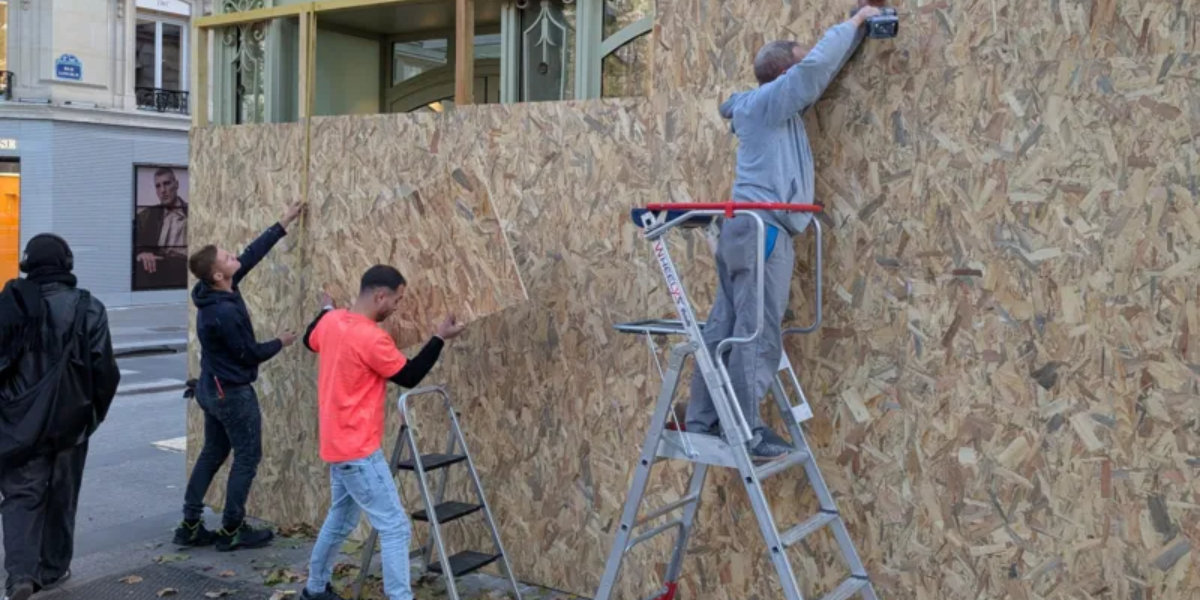
In the capital, Paris police headquarters instructed a major joint march organized by student organizations and labor unions to stick strictly to a pre-approved route bypassing central government districts, commercial avenues, and tourist centers. Despite these route restrictions, shop owners and municipal crews across central Paris were seen boarding up storefronts and securing public landmarks on Friday evening.
“There is an inconsistent picture as to what level of protest will be permitted by authorities… While some mayors have pressed ahead with broad bans, others have agreed to allow registered demonstrations.” — The Guardian
Background of the Particular Development
The current wave of nationwide unrest marks one of the most significant domestic security challenges facing President Emmanuel Macron’s administration since the height of the Yellow Vest movement in 2018 and the pension reform protests of 2023. The direct trigger for the recent escalation occurred during the coordinated national day of action on 17 October 2026.
On that day, an estimated 550,000 to 800,000 people took to the streets across France. While the majority of rallies remained peaceful, violent fringe groups—described by government officials as radical far-left agitators and opportunists—engaged in widespread property destruction. Over 1,500 commercial establishments were damaged or looted, and several public administration buildings were targeted, including the historic 19th-century Town Hall in Limoges, which suffered major structural collapse due to arson.
More than 2,400 arrests were executed nationwide in the immediate aftermath of the October 17 violence, leaving local detention centers overwhelmed and prompting emergency court scheduling. The police’s inability to contain rioting in several urban centers created severe political friction within the government, leading to calls from political opposition parties for stronger preventative measures and stricter controls on public gatherings.
Prediction: How This Development Can Affect the French Public and Business Community
Impact on the General Public
For the general public, the widespread deployment of security forces and local curfews will significantly alter daily life in major urban areas. Commuters and residents are likely to encounter severe disruptions to public transportation, closed metro stations, and restricted pedestrian access near major public squares. If confrontations between security personnel and radical groups recur, peaceful demonstrators and bystanders face increased risks of exposure to crowd-control measures, such as tear gas and water cannons. Furthermore, the government’s reliance on fast-track prosecutions and blanket gathering bans may deepen political polarization and alienate civil liberties advocates, while citizens concerned about public safety demand even stricter law enforcement.