


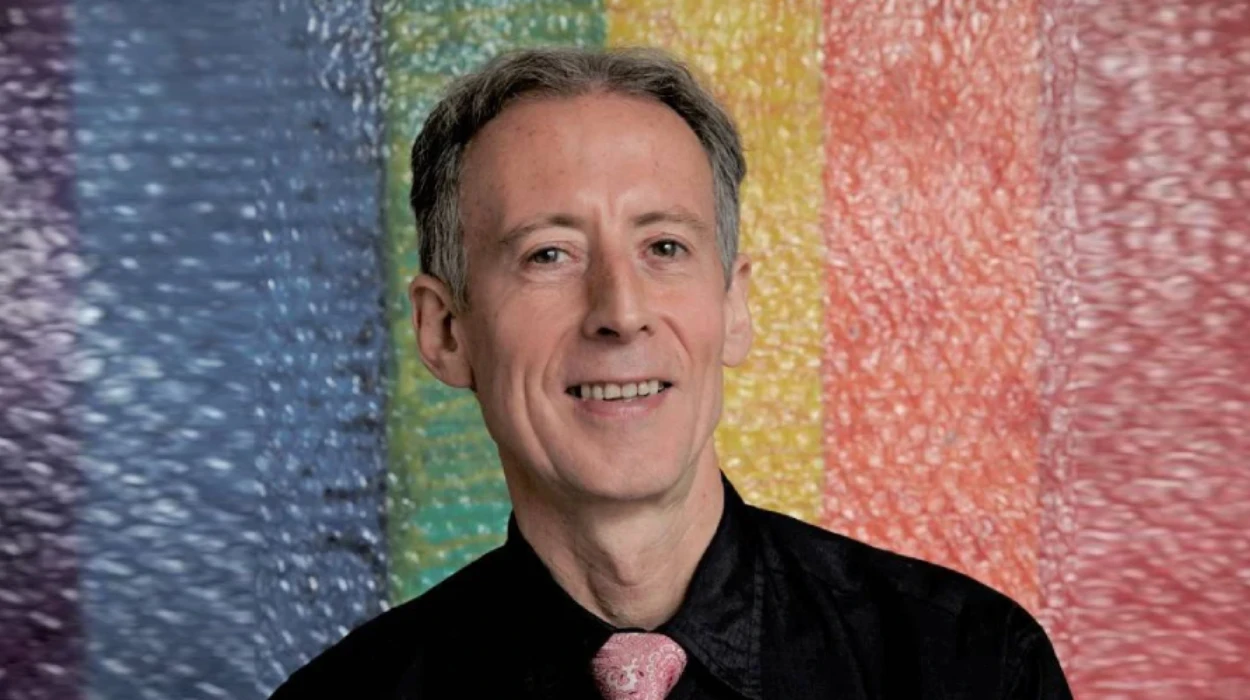
Who Is Peter Tatchell?
Peter Tatchell is an Australian-born British human rights campaigner, born 25 January 1952 in Melbourne, who has campaigned on LGBTQ+ rights, democracy, and global justice since 1967. He moved to London in 1971 and has led direct-action protests for more than 55 years through groups including the Gay Liberation Front, OutRage!, and the Peter Tatchell Foundation.
- Who Is Peter Tatchell?
- What Is Peter Tatchell Known For?
- How Did Peter Tatchell Begin His Activism?
- What Was Peter Tatchell’s Role in the Gay Liberation Front?
- What Is OutRage! and What Campaigns Did It Run?
- What Happened When Peter Tatchell Tried to Arrest Robert Mugabe?
- What Is the Peter Tatchell Foundation?
- What Is Peter Tatchell’s Latest News in 2026?
- What Happened With His Palestine Protest Arrest?
- What Happened at the FIFA World Cup Pride Match?
- What Happened at the Rally Against Antisemitism?
- What Controversies Has Peter Tatchell Been Involved In?
- How Many Times Has Peter Tatchell Been Arrested or Attacked?
- What Impact Has Peter Tatchell Had on LGBTQ+ Rights Law?
- What Is Peter Tatchell’s Legacy and Future Relevance?
Tatchell left Melbourne, Australia, for the United Kingdom in 1971 to avoid conscription into the Australian military during the Vietnam War. He studied sociology at the Polytechnic of North London, now London Metropolitan University. Within days of arriving in London, he joined the Gay Liberation Front (GLF), a group formed in 1970 to campaign for the full decriminalisation of homosexuality and against discrimination by churches, media organisations, and government institutions. His activism has since expanded beyond LGBTQ+ rights to cover democracy, civil liberties, racial equality, environmental protection, animal rights, and opposition to the death penalty.
What Is Peter Tatchell Known For?
Peter Tatchell is best known for direct-action protests, two attempted citizen’s arrests of Zimbabwean President Robert Mugabe, founding the group OutRage!, and campaigning for equal marriage, an equal age of consent, and asylum rights for LGBTQ+ people. He has also campaigned on Palestinian and Israeli human rights issues, football governance, and press freedom.
His methods rely on non-violent civil disobedience, a strategy drawn from Mahatma Gandhi, Martin Luther King, and the suffragette Sylvia Pankhurst. Tatchell has taken part in nearly 3,000 protests and direct-action interventions since 1967. Targets have included heads of state, religious leaders, sports federations, and record labels. He has appeared as a subject of the 2021 Netflix documentary Hating Peter Tatchell, which chronicles his campaigning history and the backlash it has generated from opponents across the politics spectrum.
How Did Peter Tatchell Begin His Activism?
Peter Tatchell’s activism began in 1967 at age 15 in Melbourne, when he campaigned against capital punishment and for Aboriginal Australian civil rights. His UK campaigning started in 1971 through the Gay Liberation Front, where he helped organise Britain’s first Gay Pride march the following year.
In 1972, Tatchell helped organise the United Kingdom’s first Gay Pride march, held to challenge the assumption that lesbian, gay, and bisexual people should conceal their identities. During this period, GLF activists staged sit-ins at pubs that refused to serve gay customers and organised demonstrations against police harassment of gay venues. The group also opposed the medical classification of homosexuality as an illness, a classification the American Psychiatric Association removed from its diagnostic manual in 1973.
What Was Peter Tatchell’s Role in the Gay Liberation Front?
Peter Tatchell was a leading activist in the Gay Liberation Front from 1971 to 1974, a London-based group that pioneered public LGBTQ+ protest in Britain before it disbanded. He organised direct actions against institutions the group viewed as complicit in anti-gay discrimination.
The Gay Liberation Front took inspiration from the 1969 Stonewall uprising in New York City, a series of demonstrations against police raids on a gay bar that is widely regarded as a founding moment of the modern LGBTQ+ rights movement. In Britain, GLF activists staged kiss-ins, disrupted anti-gay rallies such as the Festival of Light in 1971, and campaigned against the criminalisation of male homosexuality, which had been partially decriminalised in England and Wales under the Sexual Offences Act 1967 for men over 21 in private.
What Is OutRage! and What Campaigns Did It Run?
OutRage! was a direct-action LGBTQ+ rights group Peter Tatchell co-founded in 1990, following the murder of gay actor Michael Boothe, and it operated until 2011. The group campaigned on policing, religious homophobia, an equal age of consent, and music lyrics inciting violence against gay people.
OutRage! described itself as a group committed to non-violent direct action and civil disobedience. In 1994, the group named ten Church of England bishops it accused of publicly opposing gay rights while allegedly living as closeted gay men themselves, a campaign Tatchell later described as his greatest tactical mistake because of the privacy concerns it raised. In 1998, Tatchell interrupted the Archbishop of Canterbury’s Easter sermon at Canterbury Cathedral to protest against Church of England positions on LGBTQ+ equality; he was convicted under the Ecclesiastical Courts Jurisdiction Act 1860 and fined £18.60, which remains his only criminal conviction across roughly five decades of protest activity. OutRage! also ran the “Stop Murder Music” campaign against reggae and dancehall lyrics it identified as inciting violence against gay people, beginning with reaction to Buju Banton’s 1992 song “Boom Bye-Bye.” In 1996, the group launched the “Consent at 14” campaign, arguing for a reduced and equalised age of consent; the UK equalised the age of consent for gay and straight sex at 16 in 2000, without adopting Tatchell’s proposed lower threshold.
What Happened When Peter Tatchell Tried to Arrest Robert Mugabe?
Peter Tatchell attempted citizen’s arrests of Zimbabwean President Robert Mugabe in London in 1999 and in Brussels in 2001, citing torture charges under international law. The second attempt led to Tatchell being beaten unconscious by Mugabe’s bodyguards, causing permanent minor brain and eye damage.
On 30 October 1999, Tatchell and three OutRage! colleagues intercepted Mugabe’s motorcade on a London street. Tatchell opened the car door, physically apprehended Mugabe, and stated he was arresting him for torture under Section 134 of the Criminal Justice Act 1988, a UK law incorporating the principle of universal jurisdiction for torture offences. Police released Mugabe and arrested the activists instead; all charges against them were later dropped. On 5 March 2001, Tatchell repeated the attempt in the lobby of a hotel in Brussels, Belgium, during a Mugabe visit. Mugabe’s bodyguards beat Tatchell unconscious. He has since reported permanently blurred vision in one eye and ongoing problems with memory, concentration, and balance. In December 2009, Tatchell withdrew as the Green Party’s prospective parliamentary candidate for Oxford East, citing cumulative brain injuries from the Brussels attack, a bus accident, and a 2007 assault by far-right activists in Moscow.
What Is the Peter Tatchell Foundation?
The Peter Tatchell Foundation is a UK-registered charity established in 2011 to continue Peter Tatchell’s human rights campaigning after OutRage! disbanded. It documents and publicises cases of LGBTQ+ persecution, supports individual asylum seekers, and coordinates protests against governments and organisations accused of rights abuses.
The Foundation states its mission covers LGBTQ+ freedom, human rights, and social justice in Britain and internationally. It publishes case files on individuals facing persecution because of their sexual orientation, gender identity, religion, or political views, and lobbies international bodies including the United Nations and the Commonwealth. Tatchell serves as the Foundation’s director and continues to be its principal public spokesperson.
What Is Peter Tatchell’s Latest News in 2026?
In 2026, Peter Tatchell has been arrested at a Palestine solidarity march, protested at the FIFA World Cup, and was assaulted at a Rally Against Antisemitism in London. Each incident reflects his continued use of placard protest and physical presence at high-profile public events.
What Happened With His Palestine Protest Arrest?
Tatchell, then aged 74, was arrested on 31 January 2026 in Aldwych, London, during a march organised by the Palestine Solidarity Campaign. He carried a placard reading “Globalise the intifada. Non-violent resistance. End Israel’s occupation of Gaza & West Bank.” The Metropolitan Police alleged the word “intifada” constituted a racially and religiously aggravated offence under Section 5 of the Public Order Act 1986. Tatchell was bailed on condition that he not attend further pro-Palestine demonstrations; a magistrate later found this bail condition unreasonable and disproportionate and granted unconditional bail. On 29 April 2026, the Metropolitan Police dropped the case entirely. Tatchell stated he was consulting solicitors, Hodge Jones and Allen, about a civil claim for wrongful arrest, roughly twelve hours of detention, and the temporary ban on his attendance at Palestine-related demonstrations. This was reported as his 104th arrest or detention across 59 years of campaigning.
What Happened at the FIFA World Cup Pride Match?
On 26 June 2026, Tatchell staged a protest inside a Seattle stadium during a FIFA World Cup match between Iran and Egypt, designated a “Pride Match” to coincide with Seattle’s Pride celebrations. He displayed a placard criticising both nations’ criminalisation of homosexuality. Tatchell had written to FIFA in advance, arguing that eleven of the 2026 World Cup’s participating nations maintain anti-gay laws and that FIFA’s own statutes on non-discrimination, specifically Article 3 on human rights and Article 4.1 on non-discrimination, obligate the organisation to confirm that gay players are eligible for national team selection. FIFA’s Human Rights Team responded that player selection is the responsibility of individual national football associations, a reply Tatchell characterised as a failure to answer his central question.
What Happened at the Rally Against Antisemitism?
On 10 May 2026, Tatchell attended a Rally Against Antisemitism in Whitehall, London, carrying a placard reading “I stand with the Jewish community. Fight antisemitism. Love will triumph over hate.” He reported being physically confronted, shoved, and forced out by a group of attendees who removed a Free Palestine badge he wore and accused him of supporting Hamas. Tatchell stated police threatened him with arrest while not acting against those who confronted him. He has separately stated he attended the March Against Antisemitism in London on 26 November 2023, alongside the Chief Rabbi, following the 7 October 2023 attacks on Israel.
What Controversies Has Peter Tatchell Been Involved In?
Peter Tatchell’s controversies include disputes over OutRage!’s outing of Church of England bishops in 1994, criticism from some LGBTQ+ activists over his positions on youth sexuality debates in the 1990s, and repeated conflict with police over the legality of his protest placards. His record has drawn criticism from opponents on both the political right and sections of the political left.
The 1994 outing campaign against ten bishops drew criticism for breaching personal privacy, including from some gay rights supporters who viewed the tactic as an overreach. In the 1990s, Tatchell’s “Consent at 14” campaign, which argued for lowering the age of consent, was criticised by some commentators and later became a recurring point cited by critics attempting to discredit his broader human rights record; Tatchell has stated his position was about equalising and reducing an already-existing consent age discrepancy between gay and straight relationships, not endorsing child abuse, and has said his record on child protection issues has been misrepresented by opponents. His 2026 arrests connected to Palestinian solidarity protests have generated debate over UK policing of language such as “intifada” under public order law, with police in the “Globalise the intifada” case ultimately dropping charges after review.
How Many Times Has Peter Tatchell Been Arrested or Attacked?
Peter Tatchell has been arrested or detained by police at least 104 times and reports having been physically attacked more than 300 times during his campaigning career. He has survived two stabbing attempts, a bullet delivered through his front door, and a beating in Moscow that left him with permanently impaired vision.
During the 1983 Bermondsey by-election, in which Tatchell stood as the Labour Party candidate, he reported around 150 physical assaults and roughly 30 attacks on his flat during the campaign period, including an arson attempt and a bullet posted through his letterbox; he lost the seat by approximately 10,000 votes. In May 2007, Tatchell was punched and nearly knocked unconscious by counter-protesters, described in contemporary reporting as neo-Nazis and religious conservatives, while supporting a banned Pride march in Moscow, Russia. In 2018, he was detained by Russian police during a solo protest near Red Square on the opening day of the FIFA World Cup, calling attention to the treatment of LGBTQ+ people in Chechnya.
What Impact Has Peter Tatchell Had on LGBTQ+ Rights Law?
Peter Tatchell’s campaigning contributed to public pressure behind the equalisation of the UK age of consent in 2000, the introduction of civil partnerships in 2004, and the legalisation of same-sex marriage in England and Wales in 2013. He also campaigned against Section 28, a law restricting the discussion of homosexuality in schools.
Section 28 of the Local Government Act 1988 prohibited local authorities in the United Kingdom from “promoting” homosexuality, including in school teaching materials. Tatchell and OutRage! campaigned against the law throughout the 1990s and 2000s; it was repealed in Scotland in 2000 and in England and Wales in 2003. In 1992, Tatchell and OutRage! arranged for five same-sex couples to apply for civil marriage licences at Westminster Register Office in London, applications that were refused but that Tatchell has described as the first formal legal challenge to the UK’s ban on same-sex marriage. The Marriage (Same Sex Couples) Act 2013 legalised same-sex marriage in England and Wales, taking effect in March 2014.
Explore More about Politics:
Who Is Laila Cunningham? Biography, Story & News
Nigel Farage Resigns as MP Amid Political Pressure in the UK
What Is Peter Tatchell’s Legacy and Future Relevance?
Peter Tatchell’s legacy centres on establishing direct, non-violent civil disobedience as a mainstream tactic within British LGBTQ+ and human rights campaigning, and on sustaining an active protest career spanning more than 55 years. His continued arrests and interventions in 2026 indicate his campaigning model remains active rather than historical.
Tatchell has stated his approach draws on the precedent set by the 1998 arrest in London of former Chilean dictator Augusto Pinochet, which established that international human rights violations could be pursued against sitting or former heads of state through the principle of universal jurisdiction. He has extended this framework to campaigns targeting FIFA over LGBTQ+ discrimination in football, governments accused of persecuting sexual minorities, and, more recently, protests concerning the Israel-Gaza conflict and antisemitism. Because his campaigning method depends on physical presence at protests, court hearings, and international sporting and political events, his activity generates recurring, dateable news coverage rather than a single fixed historical record, which sustains his relevance as an active subject of ongoing UK and international human rights reporting.


