


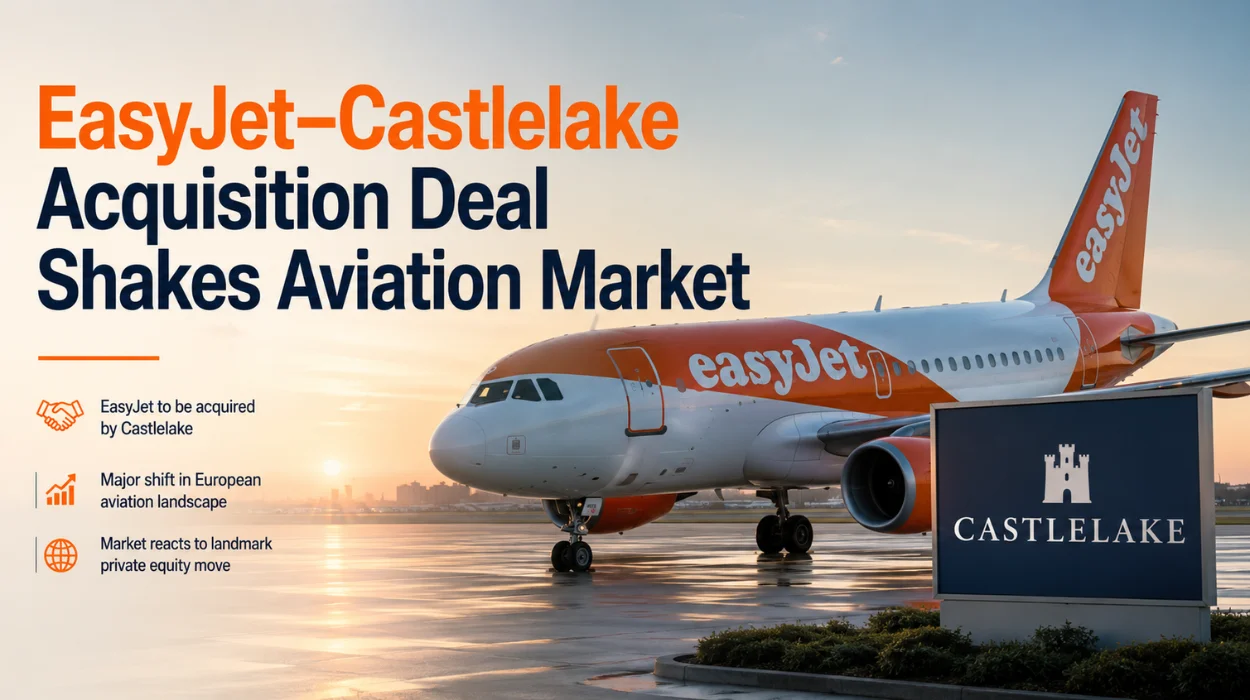
EasyJet, the United Kingdom’s largest budget airline, agreed in principle on July 5, 2026, to a takeover offer from Castlelake, a Minneapolis-based aviation investment firm. The agreement values EasyJet at approximately £5.2 billion, or £5.5 billion on a fully diluted basis, equal to roughly $7.3 billion. The deal marks the largest proposed buyout in European aviation in recent years and signals a structural shift for one of the continent’s most recognized low-cost carriers.
- What Is the EasyJet–Castlelake Acquisition Deal?
- Who Is Castlelake and Why Is It Buying EasyJet?
- How Much Is EasyJet Being Sold For?
- Why Did EasyJet Initially Reject Castlelake’s Offers?
- How Is the Deal Structured to Meet EU Ownership Rules?
- Who Are Peter Bellew and Mark Breen?
- What Is EasyJet’s Corporate History?
- Why Is EasyJet a Takeover Target Now?
- What Financial Pressures Is EasyJet Facing?
- What Happens Next in the Acquisition Timeline?
- What Does This Deal Mean for the Aviation Industry?
What Is the EasyJet–Castlelake Acquisition Deal?
Castlelake agreed to acquire EasyJet for £6.90 per share in cash, valuing the airline at £5.2 billion to £5.5 billion. The agreement is in principle, not final. A formal offer is due by August 3, 2026, under UK takeover rules.
The transaction follows months of negotiation between EasyJet’s board and Castlelake, a private investment firm specializing in aviation and transportation assets. Castlelake first disclosed its interest in EasyJet to British regulators on May 29, 2026. The final agreed price of £6.90 per share represents a 73% premium over EasyJet’s closing share price on that date. Under the UK Takeover Code, Castlelake must convert this agreement in principle into a firm, binding offer by the August 3 deadline or withdraw from the process entirely. If completed, the acquisition would take EasyJet private, ending its 31-year run as a publicly listed company on the London Stock Exchange.
Who Is Castlelake and Why Is It Buying EasyJet?
Castlelake is a US-based alternative investment firm headquartered in Minneapolis, Minnesota. It specializes in aviation, real estate, and credit investments. Castlelake views EasyJet’s fleet, route network, and airport slot portfolio as undervalued relative to long-term earning potential.
Castlelake manages assets across aircraft leasing and aviation finance, giving it direct expertise in airline valuation and fleet economics. The firm’s public statements describe EasyJet as a candidate for “transformation to a stronger, more resilient European airline.” Castlelake has expressed support for EasyJet’s fleet modernization program, which centers on newer, more fuel-efficient Airbus aircraft. Private equity and infrastructure investors have increasingly targeted European airlines since 2024, drawn by depressed valuations, high barriers to entry, and constrained airport capacity across major hubs. EasyJet’s landing slots at London Gatwick, Paris, and Geneva airports are considered strategically scarce assets that are difficult and costly to replicate.
How Much Is EasyJet Being Sold For?
EasyJet is being acquired for £6.90 per share, valuing the airline at £5.2 billion on a standard basis and £5.5 billion on a fully diluted basis, equivalent to approximately $7.3 billion. This is the fifth and final bid Castlelake submitted.
The valuation reflects a substantial escalation from Castlelake’s opening position. Castlelake’s first private proposal, submitted after its May 2026 disclosure, valued EasyJet at £5.60 per share. The firm raised its offer four additional times before EasyJet’s board indicated willingness to recommend the deal to shareholders. The table below summarizes the bidding sequence based on publicly reported figures.
| Bid Number | Price Per Share | Approximate Valuation | Board Response |
|---|---|---|---|
| 1st bid | £5.60 | ~£4.93 billion | Rejected |
| 2nd–3rd bids | Between £5.60–£6.50 | Rising incrementally | Rejected as “opportunistic” |
| 4th bid | £6.50 | ~£5.0 billion | Board opened limited data access |
| 5th bid (final) | £6.90 | £5.2–£5.5 billion | Agreed in principle |
Each rejected bid pushed EasyJet’s board to demand a higher valuation before granting Castlelake access to confidential commercial information, a standard step in UK takeover negotiations that allows a bidder to refine its offer with fuller financial visibility.
Why Did EasyJet Initially Reject Castlelake’s Offers?
EasyJet’s board rejected Castlelake’s first three bids, describing them as opportunistic. The rejections occurred while EasyJet’s share price had fallen due to fuel cost pressure linked to the Iran conflict, a period the board viewed as a temporary depression in valuation.
Boards of publicly listed companies in the UK are legally obligated to act in the interest of shareholders when evaluating takeover approaches. EasyJet’s directors argued that Castlelake’s early bids undervalued the airline by exploiting a short-term dip in the share price rather than reflecting the company’s underlying asset base, including its aircraft fleet, slot portfolio, and package holidays division. Only after Castlelake’s fourth bid of £6.50 per share did the board agree to share limited commercial data, a signal that negotiations had entered a more serious phase.
How Many Bids Did Castlelake Make?
Castlelake submitted five consecutive bids for EasyJet between late May and early July 2026. The bids rose from £5.60 to £5.90, £6.10, £6.50, and finally £6.90 per share. Each escalation followed board rejection or shareholder pressure, with Castlelake publicly appealing directly to investors after its third bid was turned down.
How Is the Deal Structured to Meet EU Ownership Rules?
The acquisition vehicle is structured with Castlelake holding a 49% stake and two European Union nationals holding the remaining 51%. This structure satisfies EU and UK airline ownership rules, which require majority control by EU or UK citizens for carriers operating intra-European routes.
European Union aviation regulation, specifically ownership and control provisions under EU Regulation 1008/2008, requires that airlines holding an EU operating license be majority-owned and effectively controlled by EU member state nationals. Because Castlelake is a US firm, it cannot legally hold majority ownership of EasyJet’s EU-licensed operating entity without violating these rules. To comply, Castlelake structured the bidding vehicle so that European nationals hold 51% of the entity, while Castlelake retains a 49% economic stake. This arrangement allows the deal to proceed without triggering a loss of EasyJet’s EU operating rights, which are essential for its routes across 38 European countries.
Who Are Peter Bellew and Mark Breen?
Peter Bellew is a former chief executive of Malaysia Airlines and served as EasyJet’s chief operating officer from 2019 to 2022. Mark Breen is chief executive of Oneiros Aerospace, a Dublin-based aviation company. Both are EU nationals and hold the majority stake in the acquisition vehicle.
Bellew’s prior operational role inside EasyJet gives the acquiring consortium direct institutional knowledge of the airline’s fleet planning, crew operations, and cost structure. His appointment to the bidding vehicle is widely interpreted as a signal of operational continuity rather than disruption, since he previously worked alongside much of EasyJet’s existing senior leadership. Breen brings aerospace industry management experience through Oneiros Aerospace, based in Dublin, a city that serves as a major European hub for aircraft leasing and aviation finance firms. Their combined 51% holding satisfies the EU nationality requirement while Castlelake supplies the majority of the capital and aviation-investment expertise.
What Is EasyJet’s Corporate History?
EasyJet launched in 1995 as a low-fare challenger airline flying from London Luton Airport to Glasgow and Edinburgh. The airline expanded through the acquisitions of Go Fly and GB Airways, grew its fleet through a major Airbus order, and became one of Europe’s largest low-cost carriers.
EasyJet’s founder built the airline on a model of point-to-point routes, direct ticket sales, and a single aircraft type strategy to reduce maintenance and training costs. The airline’s acquisition of Go Fly, a rival low-cost carrier, and later GB Airways expanded its route network and airport presence significantly during the 2000s. EasyJet subsequently placed a large order for 135 Airbus aircraft, modernizing its fleet and standardizing on the Airbus A320 family, a decision that shaped its operating economics for the following two decades. The COVID-19 pandemic forced the airline to cut 4,500 jobs and shrink its fleet in 2020, marking its most severe operational contraction. In 2021, EasyJet rejected a takeover approach from rival Wizz Air and instead raised $1.7 billion in new capital from existing shareholders to strengthen its balance sheet.
Who Founded EasyJet?
Stelios Haji-Ioannou, a British-Cypriot entrepreneur, founded EasyJet in 1995. He left the company’s board in 2010 but remains its largest shareholder, holding a stake of approximately 15% alongside his family. Haji-Ioannou has a documented history of public disagreements with EasyJet’s management over fleet expansion and growth strategy.
Why Is EasyJet a Takeover Target Now?
EasyJet became an attractive takeover target due to depressed share valuations, a large portfolio of scarce airport landing slots, and its position as one of the few remaining large independent low-cost carriers in Europe. Weak London Stock Exchange valuations have made UK-listed companies broadly attractive to buyers.
EasyJet holds landing slots at heavily congested airports, including London Gatwick, Paris, and Geneva, assets that new entrants cannot easily obtain due to strict slot allocation rules at capacity-constrained hubs. This scarcity gives EasyJet structural value independent of short-term earnings performance. EasyJet competes directly with Ryanair, Europe’s largest low-cost carrier, and has faced continuous pressure to match Ryanair’s cost efficiency. Broader market conditions have compounded the airline’s attractiveness as a target. The UK equity market is on pace to record its highest volume of mergers and acquisitions in 2026, driven by comparatively low valuations among London-listed companies relative to global peers, which has drawn interest from private equity and institutional buyers across multiple sectors.
What Financial Pressures Is EasyJet Facing?
EasyJet reported a pre-tax loss of £552 million for the six months ending March 31, 2026, despite a 12% increase in revenue to £4 billion. Rising jet fuel costs, linked to the Iran conflict, have driven fuel prices approximately 70% higher year-on-year across the airline industry.
The International Air Transport Association warned in mid-2026 that global airline profits could be cut in half during the year due to surging fuel costs. Jet fuel typically represents one of the largest single operating expenses for any airline, and a 70% year-on-year increase directly compresses margins across the sector, not only for EasyJet. EasyJet’s revenue growth of 12% during its first half demonstrates continued demand for its routes and package holidays business, but the scale of its pre-tax loss shows that cost inflation outpaced top-line growth. These financial pressures directly influenced the timing of Castlelake’s approach, as depressed near-term profitability contributed to a lower starting share price before the takeover interest was disclosed.
What Happens Next in the Acquisition Timeline?
Castlelake must submit a firm, binding offer for EasyJet by August 3, 2026, under UK takeover regulations. If a firm offer is made, the deal will require approval from EasyJet shareholders and clearance from relevant competition and aviation regulators before completion.
The current agreement is classified as “in principle,” meaning it reflects mutual intent rather than a completed transaction. UK takeover rules impose strict deadlines on bidders once a public announcement has been made, requiring Castlelake to either formalize its offer with binding documentation by the stated deadline or withdraw. Following a firm offer, EasyJet shareholders would vote on the proposal, and the transaction would likely require review by UK and EU competition authorities given EasyJet’s scale and its EU operating license. Regulatory scrutiny may also examine the ownership structure involving Castlelake, Bellew, and Breen to confirm compliance with EU nationality control requirements before final approval is granted.
Explore More about Business:
Glasgow Airport Travel Guide: Flights, Tips & Updates
Rita Seymour Sainsbury’s Case Trends Across Social Media
What Does This Deal Mean for the Aviation Industry?
The EasyJet–Castlelake deal signals growing private equity interest in European aviation assets during a period of fuel cost stress and depressed public market valuations. It may encourage similar takeover approaches for other mid-sized European carriers facing comparable financial pressure.
Private investment firms increasingly view airlines as asset-backed businesses rather than purely operational companies, given the value embedded in aircraft, landing slots, and route networks. EasyJet’s scale, with 355 aircraft operating more than 1,200 routes across 38 European countries, makes it one of the largest aviation assets available for private acquisition in the current market cycle. A completed deal would remove one of Europe’s major listed low-cost carriers from public markets, reducing the pool of publicly traded aviation stocks and potentially prompting renewed acquisition interest across the sector. The outcome of the EasyJet transaction, including how regulators treat the Castlelake-Bellew-Breen ownership structure, is likely to serve as a reference case for future cross-border airline acquisitions involving non-EU capital.